

Choosing Between Liquid and Air Cooling for Your Facility
As technologies like AI and cloud services advance, traditional air cooling struggles to maintain ideal temperatures for high-density racks. The Data Center Trends 2025 report by Vertiv predicts rack densities could surge to 500-1000kW within AI facilities. This increase necessitates more than traditional power; it demands sophisticated cooling systems to avoid overheating and the costly downtime that follows.
While air cooling has been a longstanding choice for many data centers, it often lacks the capacity to manage the surge in high-density racks. Liquid cooling emerges as a robust alternative to prevent overheating and support high-density equipment. This blog explores the differences between liquid cooling and air cooling, guiding you in selecting the best option for your operations.
Understanding Cooling Systems: Air vs. Liquid
Efficient data center cooling is crucial for continuous operation. Every device generates heat that must be dissipated to avoid overheating and system failures. Air and liquid cooling remove this excess heat through different mechanisms. Air cooling utilizes air as the medium to transfer and expel heat, suitable for environments with lower density. It typically uses precision cooling systems with varying units for racks, rows, and rooms, meeting diverse facility needs. Opt for solutions like the Liebert PDX Compact DX Cooling System or the Liebert® CW Chilled Water-cooling System for effective air cooling.
A key distinction between liquid cooling and air cooling is the medium used to dissipate heat. Liquid cooling circulates water or specialized nonconductive fluids through or near equipment. This method absorbs heat, cools the fluid, and recycles it for continuous use. There are three primary liquid cooling methods:
- Direct-to-chip cooling: Directly supplies coolant to server chips, such as the Vertiv™ CoolChip CDU
- Rear door heat exchangers: Positioned on the back of server racks to extract heat from servers, such as the Liebert® DCD Water-Cooled Passive Rack Door
- Immersion cooling: Servers are submerged in nonconductive liquid to absorb heat
These methods provide more direct cooling compared to air and are better suited for higher density setups.
Determining the Optimal Cooling Solution for Your Data Center
Choosing a suitable cooling system depends largely on your rack’s density needs. For low-density racks under 20kW, air cooling is typically sufficient, as they generate less heat. An air room cooling solution, like the Liebert DS Direct Expansion Cooling System, can effectively replace hot air with cool air.
In contrast, high-density racks using 20kW or more may require liquid cooling, becoming essential at 30kW and above. Greater power usage results in more heat, which air cooling struggles to dissipate, necessitating a shift to liquid cooling solutions. A hybrid approach, combining air and liquid cooling, can efficiently manage heat and optimize cooling.
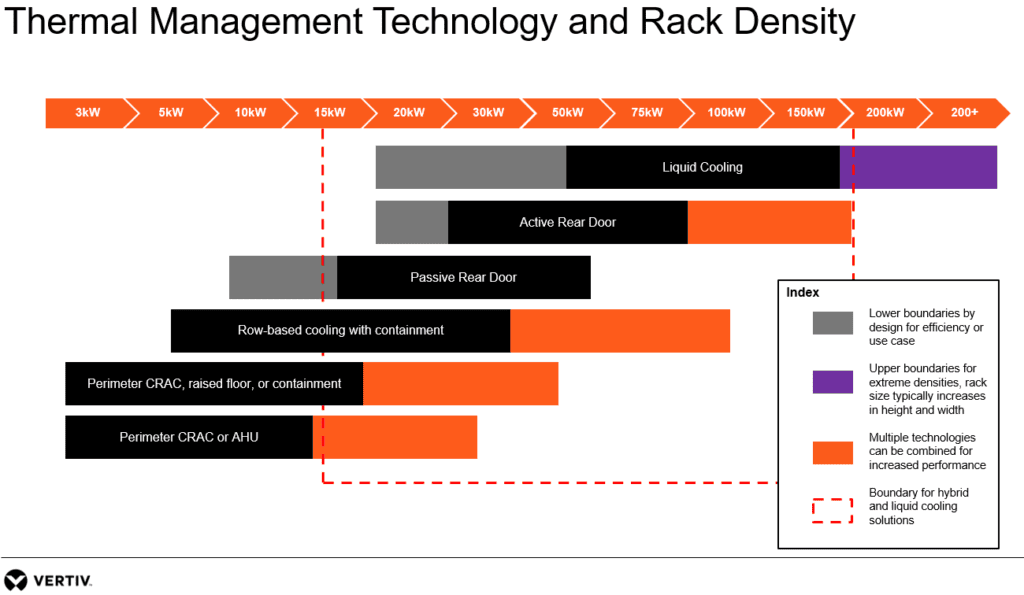
As AI and similar technologies drive the use of high-density servers, hybrid cooling solutions are increasingly popular for cost-effective heat management. Products like the Vertiv™ CoolChip CDU exemplify this hybrid model, sending liquid to chips while air conditioning maintains room temperature. This integrated approach optimizes component cooling, reducing energy consumption by utilizing pumps instead of compressors.
Seeking Comprehensive Facility Cooling Insights?
Establishing an optimal environment for your equipment extends beyond temperature control, encompassing organization, security, and technological updates. Keeping your infrastructure efficient with evolving technologies can be challenging. Sign up for our newsletter to stay informed on the latest equipment and practices ensuring seamless facility operations. For expert guidance in optimizing your cooling infrastructure, contact J.S. Fleming at 508.460.0904.